
OPTIMIZATION OF CONDENSER PRESSURE FOR A NUCLEAR POWER PLANT TURBINE WITH A SUPERCRITICAL WATER-COOLED REACTOR
Introduction
One of the reasons for implementing supercritical pressure water in nuclear power engineering is the long-term successful operational experience of more than 120 supercritical pressure condensing and cogeneration power units in conventional thermal power engineering [1, p. 60]. Supercritical pressure nuclear power plant units have a simple thermal scheme, which eliminates a large amount of expensive equipment (steam generators, pumps, pipelines, and second-circuit valves) and leads to a reduction in metal consumption by approximately 60%.
Problem statement and allowances
For the study of a nuclear power plant steam turbine unit at supercritical parameters, the scheme from [2, p. 7] of a single-circuit power unit with a supercritical pressure water-cooled water reactor (VVER-SCP) (Fig. 1) with a capacity of 600 MW without intermediate separation and intermediate steam reheating was adopted as a basis, with initial parameters: р0=25 MPa, t0=625 оС and feedwater parameters at the reactor inlet: 25.8 MPa, 348оС. The pressure in the deaerator is – 1.2 MPa.
Research aim: to calculate the turbine unit parameters for a turbine outlet pressure ranging from 6.77 to 50 kPa, taking into account the change in the relative internal efficiency of the cylinders.
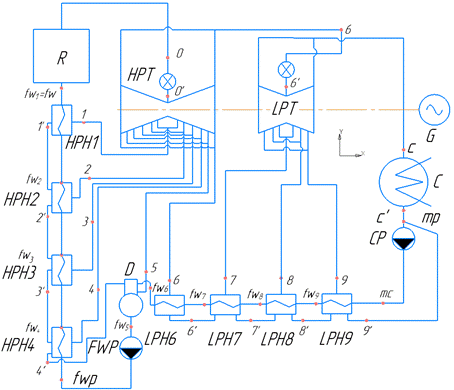
Fig.1. Thermal diagram of the power unit with VVER-SKD without intermediate separation and superheating of steam: R – reactor; HPT – high pressure turbine; LPT – low pressure turbine; G – generator; C – condenser; CP – condenser pump; HPH1..HPH4 – high pressure heater; LPH5..LPH8 – low pressure heater; D – deaerator; FWP – feed water pump; mp - mixing point; mc - main condensate
Results acquisition and analysis
The basic variant calculation will be performed for a condenser pressure  [2] using the following iterative scheme:
1. Determination of the parameters of the cycle points: Based on the initial parameters, specified losses, and adopted relative internal efficiencies of the cylinders [3, p. 26] ( ), the enthalpies and entropies of steam at the main cycle points, including the bleed-points for regenerative heaters, have been determined.
2. Heat balance of heaters and determination of steam flow rates: The system of heat balance equations for all high-pressure heaters (HPH), low-pressure heaters (LPH), and the deaerator has been solved, which made it possible to determine the relative steam flow rates.  for each bleed and the enthalpy after the mixing point
  . The specific work of 1 kg of extraction steam and the power underproduction coefficients have been determined.
 (1)
(1)
 (2)
(2)
 (3)
(3)
 (4)
(4)
Let us introduce some notation:
 (5)
(5)
The heat balance for the deaerator is:
 (6)
(6)
The heat balance for the 6th-7th heater:
 (7)
(7) (8)
(8)
The heat balances of the eighth and ninth heaters are similar.
The heat balance for the mixing point is:
 (9)
(9)
Table 1
The values of relative flow rates, specific work per kilogram of steam, and underproduction coefficients of power
|
i |
1 |
2 |
3 |
4 |
5 |
6 |
7 |
8 |
9 |
|
|
0.1303 |
0.0855 |
0.0696 |
0.0591 |
0.0091 |
0.0404 |
0.0371 |
0.0347 |
0.0322 |
|
|
94 |
236 |
379 |
524 |
704 |
811 |
928 |
1061 |
1202 |
|
|
0.0689 |
0.1738 |
0.2788 |
0.3848 |
0.5176 |
0.5963 |
0.6822 |
0.7798 |
0.8835 |


3. Calculation of flow rates and refinement of cylinder efficiencies: Based on the obtained flow rates and average specific steam volumes, the values of  and
and  were refined using empirical relationships, including a moisture adjustment for the LPC. The iterative process continued until acceptable convergence was achieved (error less than 1%).
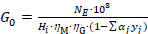
The steam flow rate to the turbine is determined by the formula
 (10)
(10)
We will ensure zero moisture at the outlet of the HPC by carrying out the expansion process in the superheated steam region. By referencing the pressure of one of the steam extractions for the HPH, we will adopt the sixth extraction as suitable for this purpose. Then the flow rate after the sixth stage is:
 (11)
(11)
Average flow rate and specific steam volume through the high-pressure cylinder HPC:
 (12)
(12)
Relative internal efficiency of the HPC for superheated steam [4, p. 146]:
 (13)
(13)
Internal relative efficiency of the LPC without accounting for moisture losses:
 (14)
(14)
Moisture adjustment:
 (15)
(15)
Subsequently, iterations of the entire above calculation are performed until the relative discrepancy between the relative internal efficiency values of the cylinders becomes less than 1%. However, when calculating the scheme for each condenser pressure, a single iteration proved sufficient; that is, the efficiencies obtained from formulas (13), (14) in [4, p. 146] turned out to be final.
4. Final calculation of parameters: using the obtained efficiency values ( ,
,  ) all cycle parameters, internal capacities of the cylinders and the turbine, absolute and relative internal efficiency of the turbine unit, and volumetric steam flow rate through the last stage were recalculated.
Internal capacity of the cylinders and of the turbine as a whole:
 (16)
(16)
Relative internal efficiency of the turbine:
 (17)
(17)
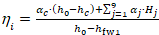
Absolute internal efficiency:
 (18)
(18)
Volumetric steam flow rate through the last stage:
 (19)
(19)
The results are presented in Table 3. It should be clarified that already at the second pressure value ( ), a transition was made to a scheme with three low-pressure heaters (LPHs) to ensure a temperature rise of at least 30°C in each of them. The last calculation variant for a condenser pressure of
  a was performed for a full-speed turbine unit while satisfying the allowable quality at the LPC outlet of
  . At the same time, the number of LPHs was reduced to two for the reasons described above. The change in rotational speed was taken into account by replacing the constant 1.005 in (14) by one.
Table 2
Data from variant calculations
|
|
|
|
|
|
|
|
|
|
6.77 |
550.57 |
0.849 |
0.9659 |
0.472 |
0.790 |
18.02 |
4954 |
|
10.1 |
566.36 |
0.860 |
0.9620 |
0.461 |
0.780 |
12.50 |
3591 |
|
13.4 |
577.60 |
0.867 |
0.9618 |
0.454 |
0.776 |
9.66 |
2865 |
|
16.7 |
587.31 |
0.873 |
0.9607 |
0.448 |
0.772 |
7.91 |
2408 |
|
20 |
595.32 |
0.878 |
0.9597 |
0.444 |
0.769 |
6.71 |
2090 |
|
50 |
642.73 |
0.904 |
0.9523 |
0.416 |
0.741 |
2.93 |
1029 |


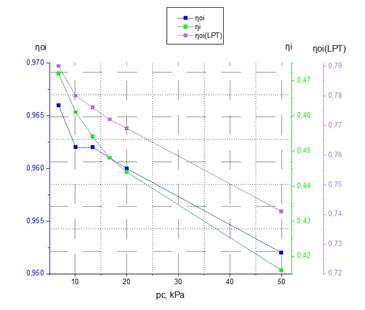
Fig.2. Dependences of the efficiency on the pressure in the condenser
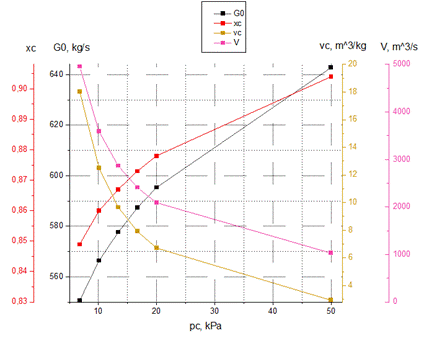
Fig.3.Dependences of the main studied quantities on the pressure in the condenser
Conclusion
The analysis showed that the absolute internal efficiency of a supercritical pressure nuclear power plant unit without separation and reheating can exceed 40%, whereas the efficiency of modern power units typically does not exceed 32–35%.
The calculation of the base case at a condenser pressure of 6.77 kPa led to an unacceptable quality (<0.86) at the end of the expansion process in the half-speed turbine. Thus, accounting for the change in the relative internal efficiency of the cylinders shifted the range of allowable pressures toward higher values, starting from 10.1 kPa. The study proved the effectiveness of increasing pressure as a tool for controlling the final moisture content.
The decrease in the relative internal efficiency of the entire turbine is contributed to by a reduction in the efficiency of the LPC, which occurs due to a decrease in the heat drop across this cylinder as the condenser pressure increases.
The mass flow rate of steam to the turbine increases by 17% due to the need to maintain constant electric capacity while the heat drop across the turbine decreases as a result of the rise in condenser pressure. Despite this, the specific volume of steam at the end of the expansion process decreases with increasing condenser pressure, which leads to a reduction in the volumetric steam flow rate through the last stage of the LPC by nearly 5 times. This indicates a reduction in the exhaust annulus area of the last stage and a decrease in its blade height, which significantly reduces the manufacturing cost of the turbogenerator
A comparison of the limiting cases (based on the steam quality at the end of the expansion process) for a half-speed turbine (pk = 10.1 kPa) and a full-speed turbine (pk = 50 kPa) showed that the absolute internal efficiency of the half-speed unit is 4.5% higher than that of the full-speed unit.
Further scientific interest lies in a more detailed calculation of the turbine, including determination of the limiting power, number of exhausts and stages, and the distribution of heat drops across the stages. Equally important is a technical and economic assessment justifying the benefit of eliminating the moisture separator-reheater from the scheme and reducing the number of low-pressure heaters (LPHs) as the back pressure increases to ensure uniform feedwater heating.
Конфликт интересов
Финансирование
Библиографическая ссылка
URL: https://eduherald.ru/article/view?id=22159 (дата обращения: 10.10.2026).
DOI: https://doi.org/10.17513/msnv.22159